Mickey Wolfmann
Inherent ViceMickey Wolfmann is a prominent Los Angeles real-estate magnate whose disappearance and apparent transformation expose the political machinery beneath the city’s development boom. His attempt to give away his fortune and make shelter free briefly suggests a break with the world he helped build; his return to familiar greed, after being taken to Ojai for what Bigfoot calls brain work, leaves that break unresolved. Around him, the novel joins a displaced neighborhood, a fatal ambush, federal intervention, and competing efforts to decide what Mickey’s life and money will mean.
Identity and Public Reputation
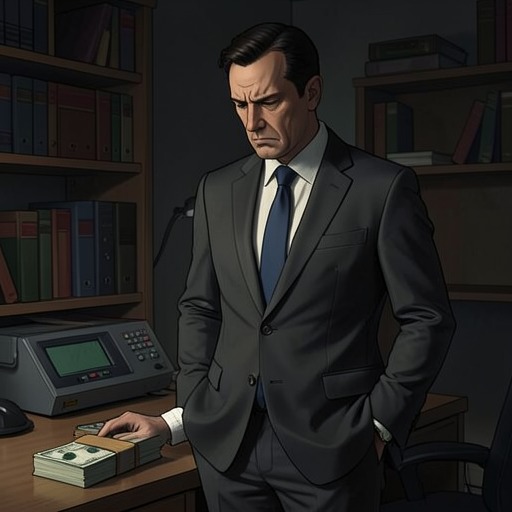
Mickey is introduced through the public image of the real-estate “big shot,” a figure whose name is familiar from the newspaper. Aunt Reet’s description places him among powerful Westside developers and financiers: a major construction and savings-and-loan operator with great wealth and a volatile investment in his own name and status. His identity is thus established not by private history but by a conspicuous combination of capital, public recognition, and forceful self-presentation.
His business reaches beyond a single project. Aunt Reet identifies Arbolada Savings and Loan in Ojai as one of the many savings-and-loan institutions in which Mickey holds a controlling interest. The deposit form that Sloane gives Doc makes this financial reach tangible: a document tied to a particular institution points back to a wider network of ownership. Mickey’s development and financial power are not separate stories; they are parts of the same system of land, credit, and investment.
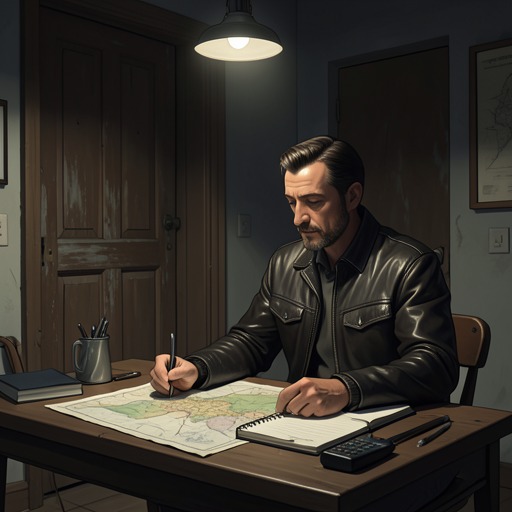
The public persona has a visual counterpart in a portrait at his house in the Los Angeles hills, where he appears to make a “game try at appearing visionary.” When Doc later glimpses Mickey in a white suit, he recognizes the same look. The image of a visionary accompanies both his role as developer and his unexpected attempt to reject the purposes to which he has put his wealth; the portrait offers an appearance, not assurance that the transformation will last.
Development and Displacement
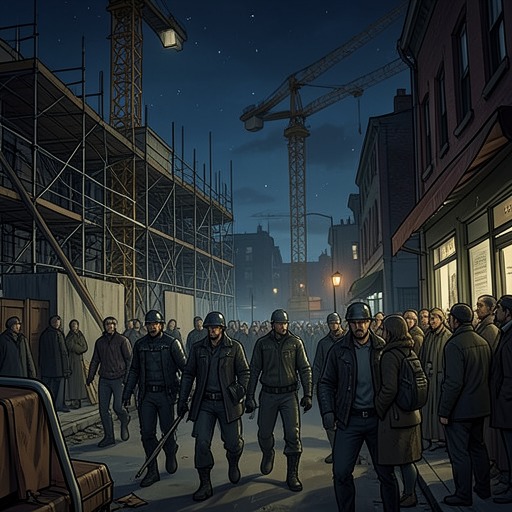
Channel View Estates gives Mickey’s power a particular address and a history of removal. Tariq explains that before the Second World War much of South Central was a Japanese neighborhood; its residents were sent to camps, and Black residents came to occupy the area. The development is placed within that succession, rather than presented as a neutral improvement to empty land. Aunt Reet likewise describes Los Angeles development through earlier displacements, including Mexican families moved from Chavez Ravine for Dodger Stadium and American Indians removed from Bunker Hill for the Music Center.
The signs directing visitors along Artesia advertise Channel View Estates as “A Michael Wolfmann Concept.” Prospective buyers arrive to inspect new houses, while Black pedestrians at the edges of Doc’s view appear to be looking for the neighborhood that has been taken away. The contrast between a marketed new development and people searching for their former surroundings makes the project’s costs visible without reducing them to a balance sheet: the land is newly organized for buyers, while the life built there has been disrupted.
Mickey’s project remains contested after his disappearance. One property owner tells Doc that local residents had worked to prevent Channel View from becoming a promise of urban blight, framing the struggle as residential owners and environmental preservation against developers such as Mickey. The dispute shows that the development can be described in sharply opposed terms: as a new real-estate venture, as a threat to the environment, and as another episode in a long fight over who gets to shape Los Angeles land.
The Disappearance and the Failed Guard
The mystery begins with violence near Channel View Estates. Bigfoot tells Doc that firearms were discharged while Doc was allegedly napping, and that Glen Charlock was found dead afterward. More consequentially for the police, Mickey, whom Glen had been assigned to guard, vanished. Bigfoot stresses the short interval before federal authorities could treat the disappearance as a kidnapping and intervene, making the case a contest over jurisdiction as well as a search for Mickey.
Boris later supplies a concealed part of the ambush’s arrangement. Glen was not meant to be there when the people seeking Mickey arrived. Puck Beaverton had been assigned to let them in and then disappear, but changed shifts with Glen at the last minute without telling him what was planned. The switch left Glen at the scene and, in Boris’s account, exposed him to a fatal outcome he had not been prepared for. Mickey’s disappearance is therefore bound to a failed inside arrangement, not simply an unexplained departure.
The disappearance quickly becomes public entertainment as well as a law-enforcement problem. At Kismet, Lark describes a sports book offering even odds on whether the construction magnate will turn up dead or alive. The wager turns uncertainty about Mickey’s fate into a marketable proposition, while the police and federal agents treat the same uncertainty as a matter of institutional control. His name circulates across the newspapers, the betting counter, and the investigation, each venue assigning a different value to his absence.
The Attempt to Give Wealth Away
During his absence, Mickey’s reported change of purpose overturns the expected direction of his fortune. A federal agent tells Doc that Mickey had decided to give away millions to people the agent disparages and had said that he could no longer accept making people pay for shelter when shelter ought to be free. The statement, which the agent says was recorded, presents Mickey’s conversion as a recognition of the harm built into his business: the man who made people pay for housing now regards free shelter as self-evident.
The change also affects institutions expecting his money. Before his disappearance, Mickey had advanced a sum toward a new wing in an expansion program. After he vanishes, the institution’s representative tells Sloane that the money should be returned while his whereabouts remain unknown; if he is heard from again, the process might resume. The conditional offer registers how thoroughly his absence interrupts plans that had seemed to rest on his wealth and apparent intentions.
The contrast between charitable purpose and accumulated property is not resolved by the mere announcement of a new conscience. Mickey’s intended generosity threatens arrangements built around his money, while his disappearance prevents those affected from knowing whether the plan can be carried out. His reform briefly makes wealth appear transferable from private control to public need, but the people and institutions awaiting an answer remain dependent on his uncertain status.
Ojai, Reappearance, and Narrative Significance
Doc sees Mickey again in a brief, uncertain glimpse. Federal agents escort him through a casino, wearing a white suit and appearing tranquilized; Doc cannot tell whether the agents have him in custody or are conducting him through the building. The sight confirms neither freedom nor captivity. Mickey is physically present, but the people around him control the passage and the interpretation of what is happening.
Bigfoot later gives a more explicit account. Mickey, he says, had stumbled into something he should not have seen, prompting men in military-style outfits to take him away. After federal authorities learned that the newly reform-minded billionaire intended to give away his money, they brought him to Ojai for “brain work,” in connection with their relationship to the Golden Fang and drug activity in the Far East. Bigfoot believes they got what they wanted: Mickey returned to his old greedy ways. His explanation connects the disappearance to what Mickey had seen and to the threat his intended redistribution posed, though the novel presents it as Bigfoot’s account rather than an independently demonstrated record.
A later legal letter offers another version of the case’s resolution. After an exhaustive review by legal, psychological, and religious experts, it concludes that Michael Zachary Wolfmann was abducted against his will and that his abductors remain beyond ordinary legal remedy. The enclosed check for ten thousand dollars reflects odds of one hundred to one, converting the question of abduction into a settled finding for the purpose of the payout without making the responsible parties reachable. The official conclusion therefore confirms Mickey’s involuntary removal while acknowledging the limits of legal recourse.
Mickey’s arc remains a conflict between a possible moral awakening and the forces that return him to his established role. His attempt to make housing free would reverse the logic of a career built on development and payment for shelter, but his disappearance, reported conditioning, and return to acquisitive behavior defeat that reversal. Around Channel View, the consequences are visible in a neighborhood remade for new owners; around Mickey himself, they appear as a struggle over whether a person can escape the economic and political order his wealth has served. The unresolved gap between the visionary portrait, the would-be benefactor, and the returned magnate gives his story its significance: transformation is imaginable, yet neither money nor conscience is outside the reach of power.